
By Cameron Layne, West Virginia Highlands Conservancy
West Virginia serves as an angler’s paradise for species such as muskie, brook trout and smallmouth bass. Among such desirable gamefish are catfishes, which are stocked in water bodies like ponds and reservoirs across the Mountain State. Channel, blue and flathead catfish are catfish species that commonly attract angling attention among residents of West Virginia. They are typically sought after for consumption, although agencies such as the West Virginia Division of Natural Resources raise select catfish species for numerous reasons, including restoration efforts (WVDNR 2026). However, our state also harbors a unique variety of stream-adapted catfishes often not encountered by the average angler.
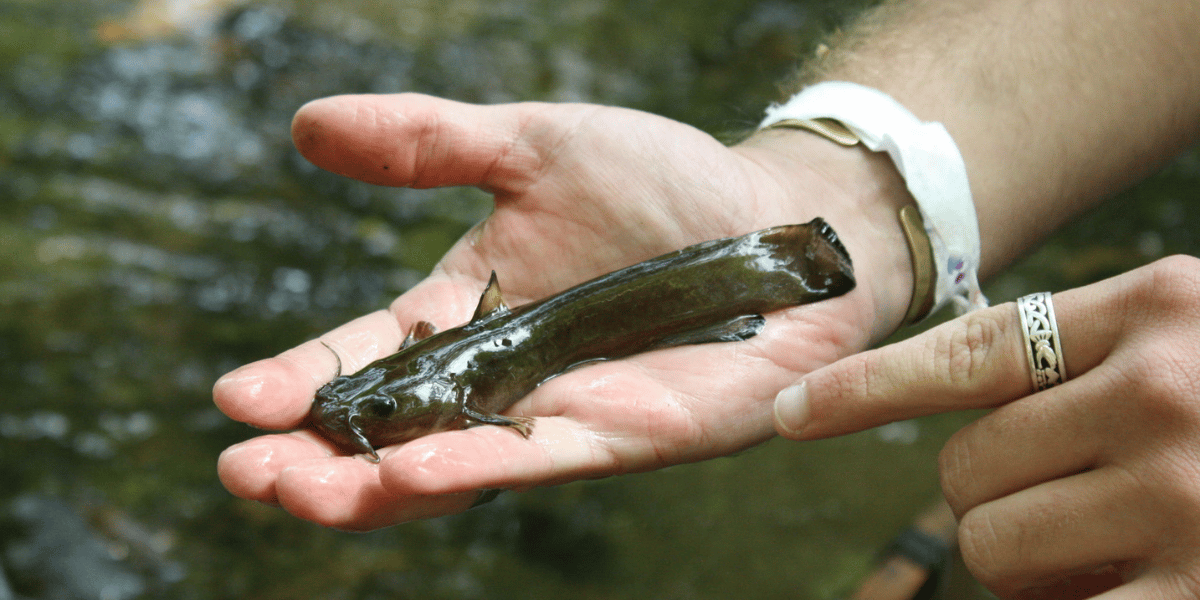
Madtoms are a distinctive group of catfishes that inhabit West Virginia’s rivers, creeks and streams. Rarely exceeding a few inches in length, these riverine catfishes are seldom targeted for sport or game, let alone observed during the day. Madtoms can be distinguished from other species of catfish most notably by their adipose fin. The adipose fin is a small, fleshy fin located on the back of certain fishes, such as trout and catfishes, between the dorsal (top) fin and caudal (tail) fin. In madtoms, the adipose fin is connected to the caudal fin, forming what looks like an extension of the tail fin that goes up and around the top of the fish. In other catfishes, like channel catfish or bullheads, the adipose fin is characteristically separate from the caudal and dorsal fins. This is the most reliable method of identifying madtoms from other catfishes, among additional features such as coloration and patterning.
Five species of madtoms call West Virginia home, with ranges reaching from the Ohio River across the state into the eastern panhandle. The largest and most common of the madtoms that can be found in our streams and rivers is the stonecat, which can reach lengths of up to 12 inches at maximum size. However, achieving this length in the wild is rarely, if ever, observed. Stonecats are native to the Ohio River drainage of West Virginia, whereas their look-alike counterpart, the margined madtom, is native to the Atlantic Slope drainage in the eastern panhandle. These drainages are split by the eastern continental divide at the origin of the eastern panhandle. Margined madtoms can be identified apart from stonecats primarily by the black trim along the margins of their fins, as well as by range and size. This species, like many other non-gamefishes, has been introduced into waters outside of its native range, including the New River drainage, which hosts many of our unique species endemic to the watershed. Luckily, their size, distribution and habitat requirements make them arguably a lesser threat than other species introduced outside of their ranges in our state.
The brindled madtom, northern madtom and mountain madtom comprise the remaining madtom species that can be found in West Virginia. These three species are often referred to as the “saddled madtom” group, referring to the patterns of dark saddles that are typically present along the top of their bodies. The saddled madtoms are the smallest of their kind, often not exceeding four inches in length as fully grown adults. Their similar patterning and coloration, paired with their adult sizes, can make them difficult to identify from one another. Their native distribution is similar to the stonecat’s, usually only observed in riverine environs of the Ohio River drainage. Madtom species can be found coexisting with one another, with oftentimes brindled madtoms and stonecats being the most widely distributed among their native ranges.
Madtoms require clean, clear, flowing water with an abundance of flat cobbles and boulders to hide under during the day. They will emerge at night and utilize their barbels, or “whiskers,” to search for prey along the bottom of the river, similar to many other catfishes. Their aversion to light can be attributed to poor eyesight. Therefore, they have evolved to rely on their barbels as highly sensitive organs to detect organisms like macroinvertebrates to feed on. Madtoms can most often be found in well-oxygenated areas such as riffles and runs where there is often an abundance of insect larvae to feed on and flat stones for nesting. These catfish are typically signs of good water quality and are often some of the first species to disappear from an ecosystem when water becomes impacted. For this reason and many others, madtoms are worth as much attention as their sportfish relatives. Although they will never reach sizes near the potential of other catfishes, their presence leaves a substantial impression on the health of West Virginia’s waters.
Sources: