
By Cindy Berdine, West Virginia Highlands Conservancy
There is a time and a season for everything. I must pause right now and take this moment to disclose in complete transparency that summer is NOT my favorite season of the year, except for one thing: katydids! I love the night sounds that happen in summer, specifically the sounds that katydids make. Why do you ask? Because they are signaling summer’s end. Hip! Hip! Hooray! Folklore tells us that about the time katydids start to sing, it is just six short weeks until the first autumn frost. You see, fall IS my favorite time of year.
There are all sorts of folklore stories that talk about katydids and how they got their name, their little song or the night noise they make. In my opinion, katydids are some of the most fascinating insects. Katydids may also be called bush crickets, or a long time ago, they were even called long-horned grasshoppers. Katydids belong to the order Orthoptera, which they share with crickets and grasshoppers. Katydids belong to the family Tettigoniidae.
There are all kinds of katydids, with 8,000 different species worldwide, to be almost exact. True katydids (Pterophylla camellifolia), interestingly enough, only have four species in North America. The three most common types found in West Virginia are the greater angle-wing katydid (Microcentrum rhombifolium), the common true katydid (Pterophylla camellifolia) and the oblong-winged katydid (Amblycorypha oblongifolia).
The oblong-winged katydid comes in different colors: green, tan, pink, dark tan, yellow or orange, with pink actually being its dominant color. How cool is that? Another noteworthy piece of information: if a pink adult breeds with a green adult, they produce a half-pink, half-green offspring. Unfortunately, the pink katydid stands out in nature, so it can become easy prey.
The common true katydid is the noisiest, with its “ch-ch-ch” and then maybe a “katydid-did-did” or just a single “katydid.” I think it is fun listening to them at night and hearing how they communicate with each other. If you are lucky, sometimes you may even hear them form a duet and sing together.
Different species have different mating calls. Some are trying to catch a mate, defend their territory or stake their ground. Katydids that live in seasonal areas typically live less than one year and only produce one generation of offspring. The egg stage of a katydid’s life cycle is the only stage capable of surviving the winter season.
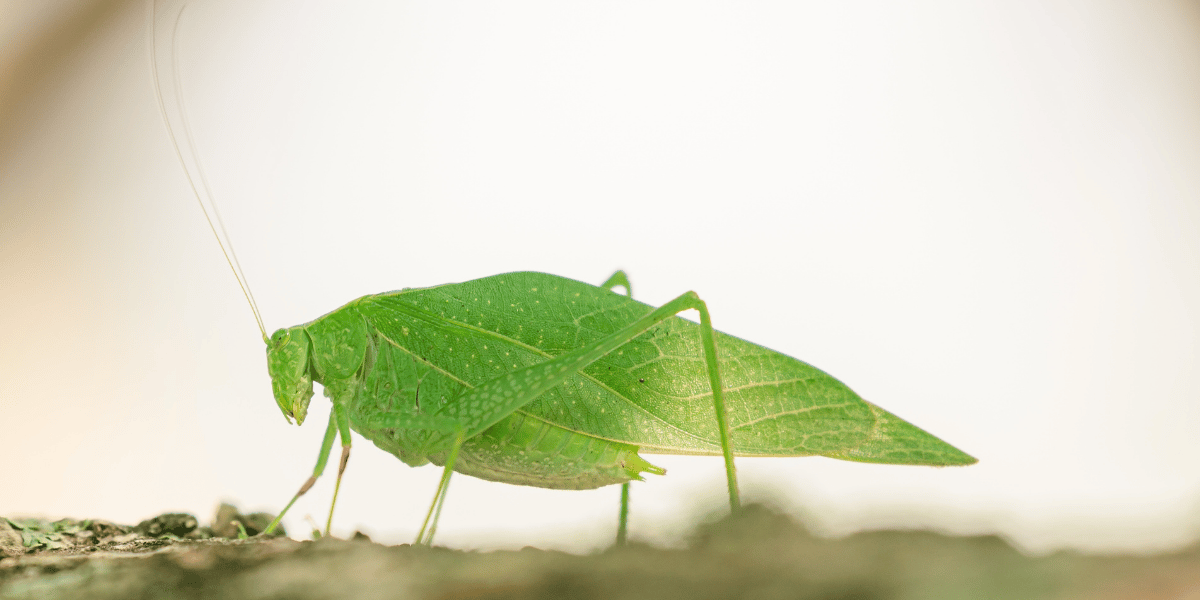
Katydids have a remarkable defense system because they fly very poorly, if at all, so they hop, leaving themselves very susceptible to predators. They camouflage themselves among the tops of trees or in leaf matter. Bats are one of their predators.
Some key features in identifying katydids are their antennae. They are extremely long and can sometimes be two to three times their body length. A katydid can be as big as your thumb. They are usually green, with remarkable vein patterns mimicking a leaf. Their legs are powerful and adapted for jumping; their femurs are thicker than their other leg segments. They hear through their forelegs rather than their abdomen like other grasshoppers. They are primarily nocturnal and are heard more than they are seen.
So, if you have nothing better to do tonight, here is one more folklore fact you can try with katydid sounds. You can discover the temperature of the night by counting how many times a katydid calls in a minute, adding 161 to that number, then dividing by three. That should equal the temperature.
I know what I am going to try tonight when I listen to this wonderful summertime symphony of sounds.