
By Christa Clasgens, West Virginia Highlands Conservancy
It is not uncommon to find ourselves investing our time in a new hobby, only to watch it grow into something much more. In fact, it’s a shared experience. Throughout my own journey of becoming involved in the outdoors, I’ve watched thousands of others go through the same transformation. We all start at square one, and many of us, if not most, go down our own rabbit holes, only to eventually arrive in the same new world together.
By this, I mean the pipeline that begins with an outdoor hobby or activity and often leads us toward becoming conservationists and environmentalists. But why does this happen? Is it possible to simply enjoy the hobby for what it is without allowing it to evolve into something deeper or change the way we see the world? The answer is yes, but I believe it’s less common than we might think.
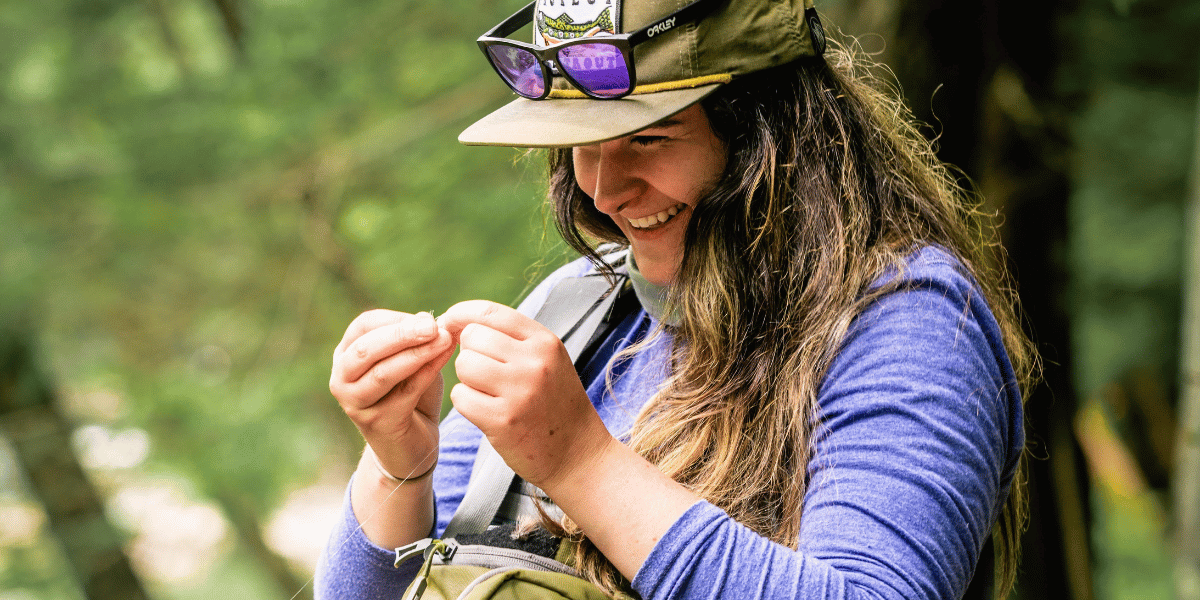
Before I began fly fishing, I was a traditional angler. Fishing for bass with a spinning reel was my go-to, and I enjoyed spending time on lakes and ponds. When I made the transition to fly fishing, however, everything began to shift.
The intricacies of fly fishing were more than I ever expected, and I couldn’t help but immerse myself in it. I pored through information online, listened to professionals, studied techniques and locations, and became fascinated by fly patterns. Before long, I found myself outside nearly every day, fishing or searching for new waters to explore with whatever small pieces of knowledge I had gathered.
Years of this led to proficiency, and proficiency led to new challenges.
At some point in the learning process, we experience what I like to call “the shift.” The water we had fished for years suddenly seems different. The behavior of the fish changes. Rivers and creeks no longer look the way they did five years ago, and we are forced to adjust.
More often than not, these changes leave us with questions. Why is the water different? Why are the fish behaving differently? What can I do to adapt to this new reality?
It’s at this point in our angling journey that we begin turning to science, research and professionals for answers. We adapt to our changing circumstances, and we learn.
We begin learning about the health of our waterways and how that health directly impacts the fish we pursue. We learn how shifts in climate can influence the outcome of our fishing days. And, perhaps most importantly, we begin to understand that many of the forces affecting our water and fish are the result of human activity.
Thankfully, that last realization is also what gives people like you and me a voice and a stake in what happens to our land and water. Our understanding of the forces we control as humans becomes another part of our growing knowledge as anglers. The rivers and creeks we frequent become more than places to fish; they become places we feel compelled to defend.
Our unconditional support for these waters grows as we watch state and industrial interests propose projects or practices that could degrade them. Protecting our waterways from harm is no longer something that happens somewhere beyond our reach. It becomes a personal priority.
The history behind our present-day fisheries can leave us dumbfounded. Across our state, many of our waters are still recovering from decades of exploitation by the timber industry, oil and gas extraction, coal mining and countless other activities. The condition of our rivers today cannot be separated from the history of how we have used, and sometimes abused, them.
It becomes difficult to keep fishing at face value once you learn the history of the rivers you love.
Eventually, an emotional connection becomes intertwined with our knowledge. We no longer see these waterways simply as places where we spend our weekends. They become part of us. That emotional connection to the places we love may be the defining moment in this journey from recreation to stewardship.
If you find yourself getting into fly fishing, hiking, climbing, rafting, biking or any other outdoor pursuit, you can expect to become immersed in the joys of it. You will deepen your knowledge and experience, and somewhere along the way, you may discover a passion deep within you that you never knew existed.
Your love and admiration for what began as a hobby can eventually come full circle. You may find yourself taking a stand against anything that threatens to take that passion away or diminish the places and conditions that make it possible.
Everyone should find something they love doing outside.
And once you find that special activity that brings you joy, gives you purpose and makes you feel connected to something larger than yourself, don’t hesitate to protect it for all it’s worth.