This is my personalization of the letter you provided to oppose HB 4013. I thought you might want a copy. Thank you for your extraordinary work. I am grateful to be able to support your efforts. We are fighting the same fight in MD and we are working to get a massive data center expansion passed by our County Council on a referendum and before the voters who are opposed to it. I don’t know your state governmental situation, but is that an option available to you? Difficult to do.
Also, today, I heard on NPR, All Things Considered, that the current Federal administration is weakening the regulation of small modular reactors in many ways including contaminating ground water. Requirements across the board have been loosened and done in secret.
And a last question. I am a writer and I have been writing essays about different farmers and communities being adversely affected by energy development and data centers in MD. I am now writing the story of a Davis resident whose family has lived in the Thomas/Coketon/Davis area for three generations. In addition to being active on behalf of the WV environment and its citizens, do you ever publish articles that personalize the losses that come with these corporate decisions?
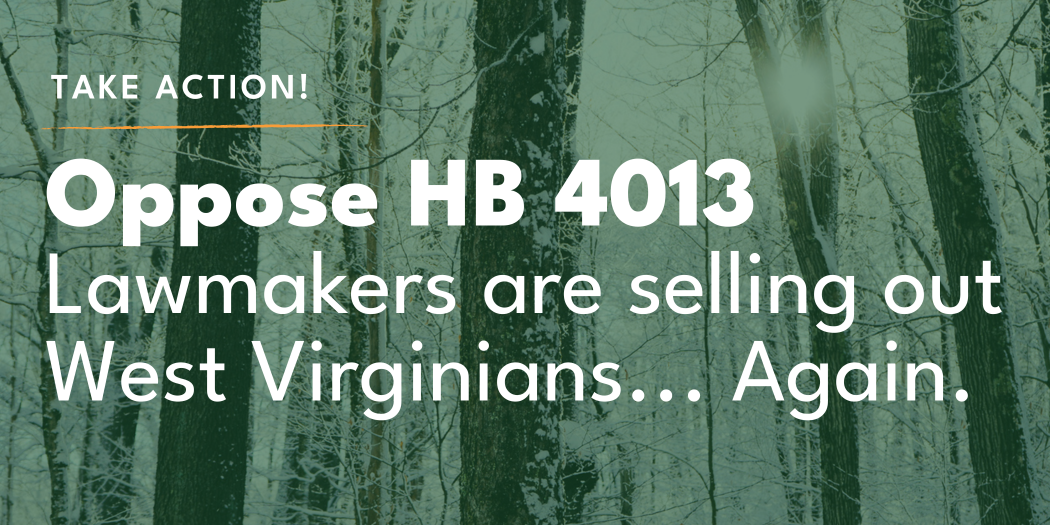
I’m writing to express deep concerns over HB 4013 (relating to the Mountaineer Flexible Tax Credit Act of 2026). HB 4013 gives special treatment to industry, meaning they don’t need to support the communities hosting them, while we pay the price – literally. Data centers do little to benefit host communities or West Virginia economically. Existing facilities are known to employ very few people and, because they employ few people and are largely exempted from taxes, almost none of the sales revenue they generate ever lands in host communities.
West Virginians and small businesses pay their share for public services, like emergency response, infrastructure, roads, and more. This money helps keep our communities safe and livable.
Please oppose HB 4013 and invest in what matters: opportunities for our local businesses and workers, maintaining and improving basic services and infrastructure, making life better for our communities across the state.
Although I live in Maryland currently, I was born in Wheeling, WV and I have spent years returning to WV and researching a novel-in-progress that covers the years when WV was shorn of every stick of lumber between 1900 and 1922. That was an extraction economy that provided time-limited employment, caused flooding, fires, and such severe destruction of the soil that some of the ground has never recovered. The railroad and lumber barons grew wealthy. Big tech and data centers are another extraction economy. If HB 4013 passes, then the citizens of WV have lost in every possible benefit. The fragile environment will be harmed again and the promises of tax revenue for the needs of its citizens will go up in smoke.
I believe we are living in a new Gilded Age, which a past President, Rutherford B. Hays described as “government for the corporations and by the corporations” in 1886.


Comment(1)
Susan Gordon says:
January 28, 2026 at 7:06 pmDear West Virginia Highlands Conservancy,
This is my personalization of the letter you provided to oppose HB 4013. I thought you might want a copy. Thank you for your extraordinary work. I am grateful to be able to support your efforts. We are fighting the same fight in MD and we are working to get a massive data center expansion passed by our County Council on a referendum and before the voters who are opposed to it. I don’t know your state governmental situation, but is that an option available to you? Difficult to do.
Also, today, I heard on NPR, All Things Considered, that the current Federal administration is weakening the regulation of small modular reactors in many ways including contaminating ground water. Requirements across the board have been loosened and done in secret.
And a last question. I am a writer and I have been writing essays about different farmers and communities being adversely affected by energy development and data centers in MD. I am now writing the story of a Davis resident whose family has lived in the Thomas/Coketon/Davis area for three generations. In addition to being active on behalf of the WV environment and its citizens, do you ever publish articles that personalize the losses that come with these corporate decisions?
I’m writing to express deep concerns over HB 4013 (relating to the Mountaineer Flexible Tax Credit Act of 2026). HB 4013 gives special treatment to industry, meaning they don’t need to support the communities hosting them, while we pay the price – literally. Data centers do little to benefit host communities or West Virginia economically. Existing facilities are known to employ very few people and, because they employ few people and are largely exempted from taxes, almost none of the sales revenue they generate ever lands in host communities.
West Virginians and small businesses pay their share for public services, like emergency response, infrastructure, roads, and more. This money helps keep our communities safe and livable.
Please oppose HB 4013 and invest in what matters: opportunities for our local businesses and workers, maintaining and improving basic services and infrastructure, making life better for our communities across the state.
Although I live in Maryland currently, I was born in Wheeling, WV and I have spent years returning to WV and researching a novel-in-progress that covers the years when WV was shorn of every stick of lumber between 1900 and 1922. That was an extraction economy that provided time-limited employment, caused flooding, fires, and such severe destruction of the soil that some of the ground has never recovered. The railroad and lumber barons grew wealthy. Big tech and data centers are another extraction economy. If HB 4013 passes, then the citizens of WV have lost in every possible benefit. The fragile environment will be harmed again and the promises of tax revenue for the needs of its citizens will go up in smoke.
I believe we are living in a new Gilded Age, which a past President, Rutherford B. Hays described as “government for the corporations and by the corporations” in 1886.
Sincerely,
Susan Gordon
segmessages@gmail.com
301-402-2446