By Olivia Miller, West Virginia Highlands Conservancy
As West Virginia prepares to spend $542 million building Corridor H to the state line, blasting through the George Washington National Forest, Virginia’s transportation agency found its existing road can handle projected traffic for another 76 years.
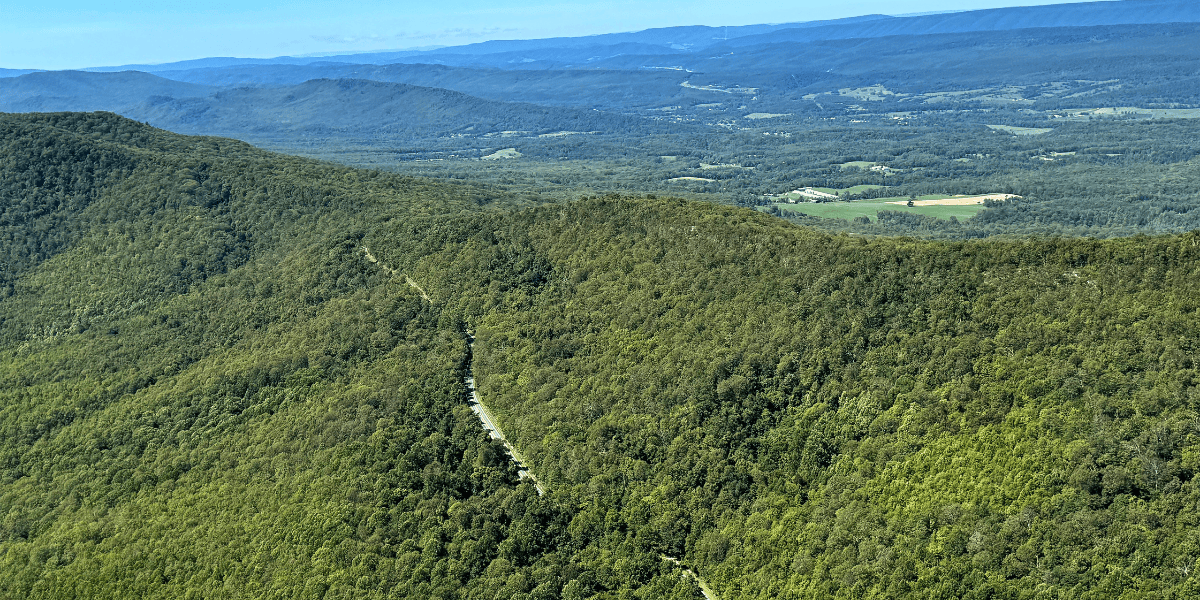
There is a winding two-lane road on the other side of Great North Mountain, just across the West Virginia state line, that tells us a lot about the future of Corridor H.
For decades, West Virginia has continued to push Corridor H eastward through some of the most rugged and beloved terrain in the Highlands. Now, the West Virginia Division of Highways is preparing to spend roughly $542 million to build the easternmost segment of Corridor H from Wardensville across Great North Mountain to the Virginia state line.
But there is still no Corridor H in Virginia, and there likely will never be, at least not in many of our lifetimes.
A new Virginia Department of Transportation study makes that reality even harder to ignore. A November 2025 Route 55/US 48 (John Marshall Highway) Corridor Study examined the 14.4-mile stretch of road from the West Virginia state line to the I-81 interchange in Virginia. The study was requested to identify existing safety or operational issues and to understand how West Virginia’s continued construction of Corridor H could affect traffic flow, operations, and safety conditions in Virginia.
VDOT found that Route 55/US 48 is currently operating acceptably, with level-of-service conditions of B or better. The study also found that conditions are expected to remain acceptable through 2102, even when using a conservative 3% annual traffic growth rate. That growth rate is more than double the 1.43% rate used in West Virginia’s own Corridor H Supplemental Environmental Impact Statement.
In plain terms: even if West Virginia builds Corridor H to the state line, Virginia’s existing road is expected to keep functioning acceptably for generations.
The study also states that while West Virginia plans to fully construct Corridor H, there are no current plans to do so in Virginia. Virginia’s Commonwealth Transportation Board selected a location for Corridor H in Virginia in 1993, but rescinded its support two years later following significant public disapproval.
The study does identify real safety concerns along Route 55/US 48, including crash hot spots, roadway departure risks, and several intersections where targeted safety improvements may be appropriate. But those concerns do not support a new four-lane highway across the mountain. VDOT instead points to focused safety measures, such as improved signage, rumble strips, pavement markings, and possible intersection improvements.
This is exactly the kind of practical, targeted approach West Virginia should be considering before spending hundreds of millions of dollars to force Corridor H through the last remaining stretch to the Virginia line.
Comments(2)
JW says:
June 25, 2026 at 8:12 pmIt’s not $542 million for the last segment from Wardensville to the Va. line. Where does that number come from? The bid was $86 million.
Olivia Miller says:
June 25, 2026 at 8:15 pmOn the permitting dashboard for federal infrastructure projects here:
https://www.permits.performance.gov/permitting-project/dot-projects/appalachian-corridor-h-wardensville-virginia-state-line-project