

By Sean O’Leary, Ohio River Valley Institute
Last December, I wrote a blog post titled, “The Appalachianization of America’s Economy”, in which I observed that the AI and data center boom, which has recently been a principal driver of overall GDP growth, seems to be giving rise to a recurrence of a phenomenon previously seen in Appalachia’s natural gas regions – a sharp increase in growth as measured by GDP accompanied by stagnation or outright declines in local measures of prosperity, including jobs, incomes, and population.
Recent data bear this out. Since 2005, real GDP in the US has grown by just over 50%, but the Information sector, driven largely by AI and data centers, has grown by almost three times. Yet, employment in the Information sector has actually declined.
This disconnect between GDP growth and growth in jobs not only undercuts the value of GDP as a measure of general prosperity, it also signals another problem – a rising share of income allocated to capital accompanied by a decline in income allocated to labor. This is an inevitable consequence of the growing importance of a capital-intensive and non-labor-intensive sector, such as Information, and it is an engine for growing income and wealth inequality.
Recent pieces by Harold Meyerson and Jared Bernstein, who provides the following chart, discuss this problem in greater detail.
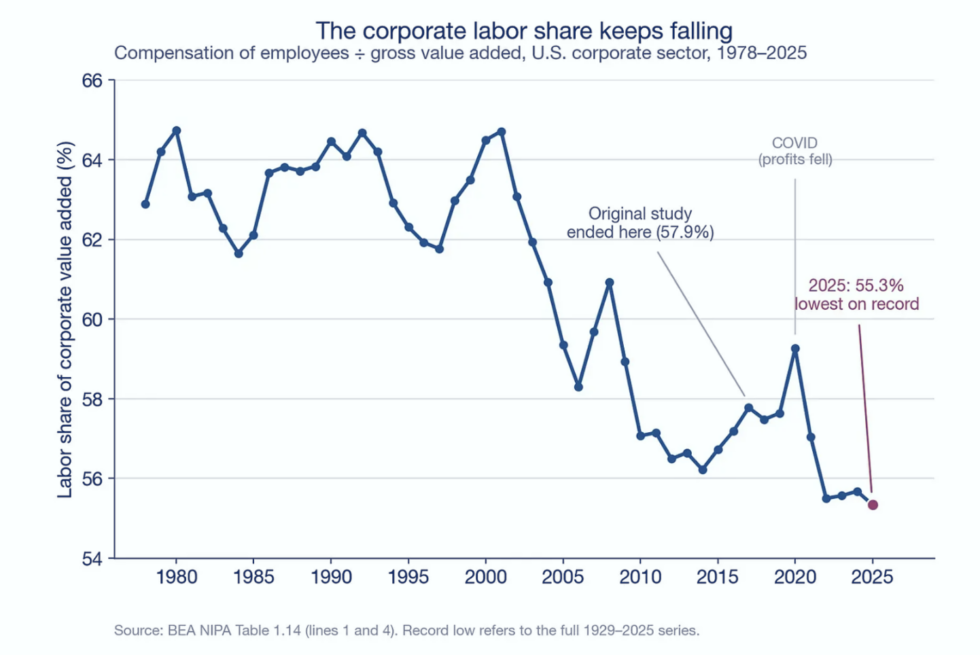
But it’s also important to understand that growing income and wealth inequality doesn’t occur just along class lines. It occurs along geographic lines as well. As hyperscalers seek locations that offer access to abundant and inexpensive energy, communities in rural parts of Ohio, Pennsylvania, Indiana, Texas, and other states are seeing a proliferation of data centers that generate immense amounts of investment and revenue, all of which counts toward GDP, but because data centers are so non-labor-intensive, very little of the money that is invested or the revenue the facilities generate lands in local economies.
The most readily available remedy for this problem is taxes, which can generate large windfalls for host communities. That’s a key point in a recent piece by Jane Flegal, who suggests ways in which we can make data centers good citizens.
However, many communities and states are abating or providing exemptions for sales and property taxes in order to encourage data center development. Tragically, this ensures that data centers, as prolific in generating revenue as they might be, will provide negligible local economic benefit. As a result, many of these communities will likely fall into the same trap that many Appalachian communities did during the natural gas boom, when they experienced skyrocketing GDP growth accompanied by relentless declines in jobs, incomes, population, and overall prosperity.