By C.A. Holmes
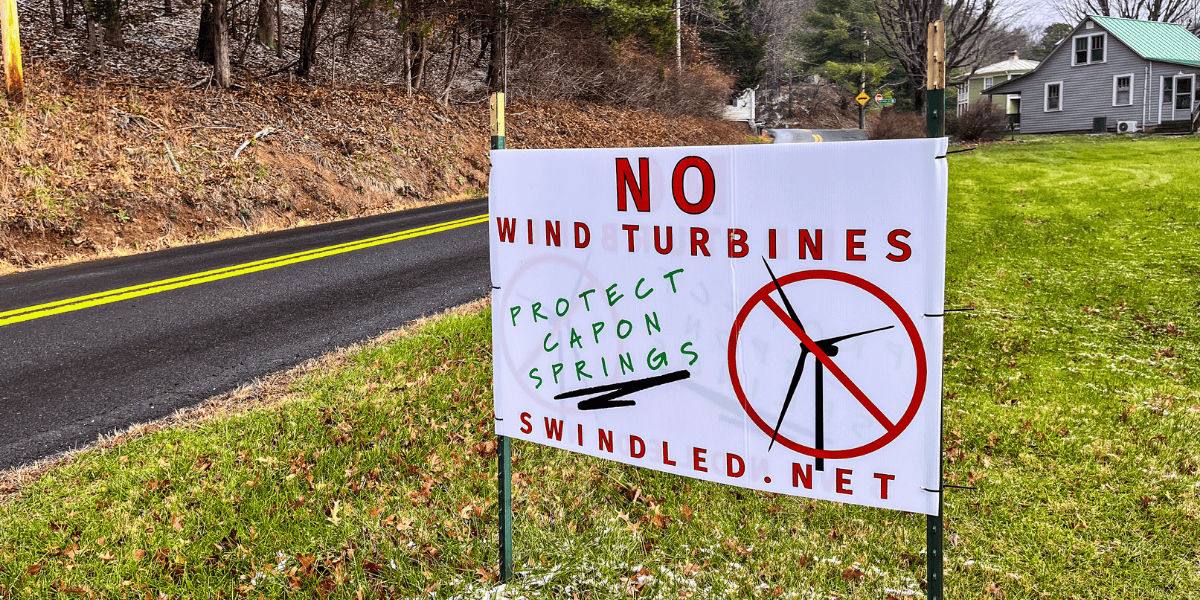
Every two weeks I make a trip down the highway to get water from the local spring. A mundane task that keeps me from being solely reliant on my town’s water supply in Wardensville, where “boil water” notices are frequently dispatched to customers. Over the last few months, as I drive up the holler just a few miles out of town, I’ve noticed an increasing number of yard signs occupying more and more driveways and corners, all bearing the same word: “Swindled.”
Now this word might sound familiar to you from a recent issue of The Highlands Voice back in May 2025, when community resident Jacob Kirk wrote about the Capon Springs Resort and Farm announcing the leasing of the top of the ridge in Capon Springs to Competitive Power Ventures (CPV). The company plans to build up to 25 wind turbines, each 595 feet tall—40 feet taller than the Washington Monument. CPV is a subsidiary of energy conglomerate Global Infrastructure Partners, whose parent company is none other than BlackRock Investments. Yes, that BlackRock—the largest asset manager in the world. So what has this energy giant been up to since May? Plans and tactics never before seen in a small community in Hampshire County, West Virginia.
This summer, CPV attempted a community information meeting at Capon Springs Resort and Farm, inviting residents to discuss the wind turbine proposal with CPV representatives. What happened instead was a group from the public firm Orion Strategies arrived in CPV polo shirts with prepared responses and easels. When a community member asked a question to the project manager about reclamation plans for the project area after the turbines reached the end of their lifespan and the lease had expired, Orion CEO Curtis Wilkerson stepped in, attempted to control the narrative, and rebuked the resident for asking the question. The meeting then descended into disarray, with no new information was provided nor any community concerns heeded.
Fast forward to November 2025 and to what the Swindled campaign hoped would be its best chance to stop turbines from towering over their community and altering their natural resources forever. The Hampshire County Planning Commission was scheduled to vote on amendments to the county’s Subdivision and Land Development Ordinance (SALDO).The proposed amendments would place restrictions on wind energy that would make turbines ineligible for construction in Capon Springs. But on the evening of the meeting, no vote was held due to a procedural oversight in which the vote was inexplicably absent from the agenda. Later, Commission President John Hicks suggested halting the vote until the Commission had “heard from everyone.” This happened to include CPV’s attorney, Mark Sadd—listed byBest Lawyers In America lists as a “best lawyer” in eminent domain, condemnation law, and zoning and land use law. Mr. Sadd was one of two commenters opposing the amendments, and neither party was from Hampshire County.
After public comments concluded, the commissioners exited the public space for an executive session. Upon returning, Commission President Hicks proclaimed that the “legal review” of the amendments were “incomplete” and needed further review, but provided no timeline for said review. That’s where the issue currently rests as we look toward 2026.
So what, you might ask, does all of this have to do with my once in a fortnight chore to collect clean water up a holler a few miles away? Capon Springs, West Virginia, is so named for the historic spring that hundreds of Appalachians collect their water from—includeing me. The resort has now put in jeopardy the very spring that provides their namesake, all so their luxury resort and farm won’t have to modify their business plan that has rendered itself unsustainable in the modern age. Their solution: offer up the top of their community’s ridge to an energy company to use and abuse so they may greenwash a luxury resort, attract a new breed of guests, and cash large monthly checks from the largest asset manager in the world.
We all want a future where renewable energy is sustainable. But this is not the way to do it.