
By Christa Clasgens, West Virginia Highlands Conservancy
A long-winded debate among anglers that’s actually quite simple – is it a native or a wild fish? Oftentimes, anglers mistakenly use these two words interchangeably. The truth behind these definitions is quite staggering. In today’s world, West Virginia boasts multiple species of trout, including brook, brown and rainbow trout, alongside the hybrid tiger trout and genetically modified golden rainbow trout. Only one of these trout species is truly native to not only West Virginia but all of Appalachia. The brook trout has been Appalachia’s only native trout for approximately 1.6 million years and still is!
Before human arrival, these fish occurred naturally on the eastern side of the U.S., uninhibited by outside forces, and today they survive in typically smaller, cold-water streams across the higher-elevation mountains of Appalachia. The irony of the brook trout is that it is not considered a true trout, but a char! The char family is closely related to trout but differs in a few biological ways, such as markings, color, tail shape and more. But trout and char belong to the Salmonidae family and share many of the same traits.
It’s likely the few similarities between these two groups of fish confuse anglers, but history can highlight how we’ve arrived at our modern fisheries today. The rainbow trout was first introduced to Appalachia during the late 1870s by federal and state fish commissions to offset the collapse of native brook trout due to industrial timber clearing. They were brought from Pacific slope drainages, bred and stocked in the waters we fish today.
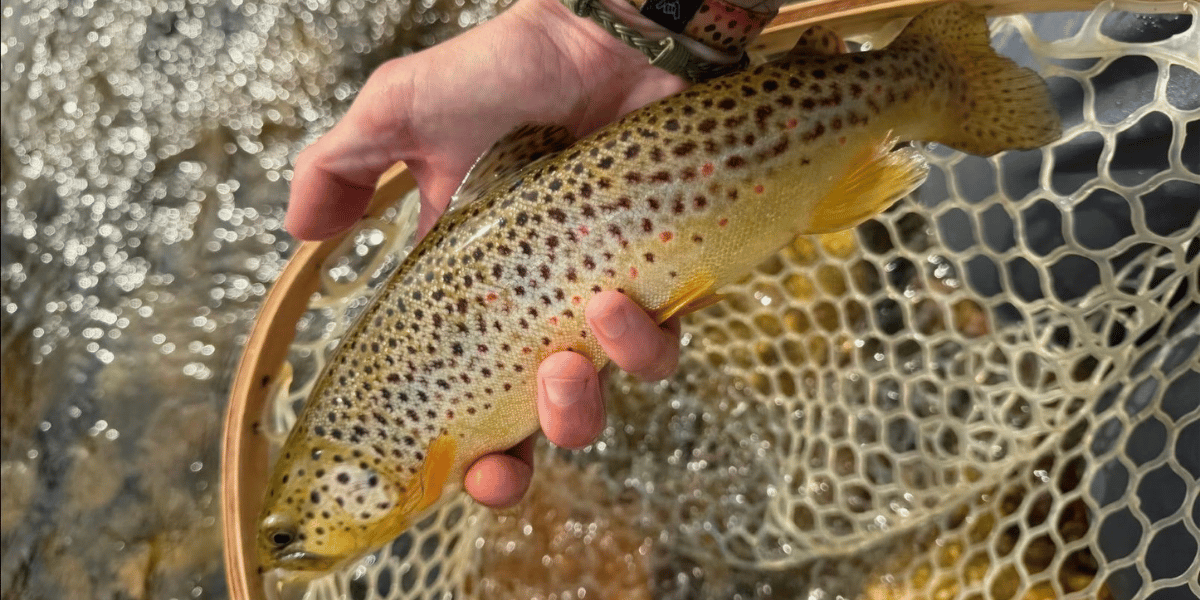
Not long after the rainbow, the brown trout made its debut in America. The brown trout is native to Europe, with the introductions in America likely originating from Germany. Brown trout eggs were harvested and brought by boat to North America in the 1880s, later making their first appearance in Appalachia shortly after. This trout species introduction was intended to provide a prized game fishery while also offsetting the collapse of native brook trout.
In West Virginia, our state hatcheries still breed and stock rainbow and brown trout, and in some prime areas where they are able to survive without intervention, they naturally reproduce. A fish that exists in any stream or waterway by natural means is considered wild. These fish are significant in our waterways as well. When a fish can reproduce, and its offspring survive to adulthood, this is a great indication of stream health. Trout are very sensitive to pollutants, higher water temperatures and lack of available biomass or food in the ecosystem of the waters they inhabit. So wild, naturally reproducing trout tell us a great deal about how healthy and naturally sustainable any given waterway can be.
It’s important to understand that even if trout like rainbow, brown, tiger and golden rainbow are inhabiting our waterways either through natural means or through human intervention, they are all technically non-native and, in some cases, invasive. Each of these trout can be contributing to outcompeting or directly impacting the survival of our native brook trout that have been struggling since the timber industry.
There’s a reason the brook trout is our state fish – it’s our only native trout species; all others were brought to the Mountain State by human intervention. The beauty of the brook trout not only serves as a sign of native Appalachian significance, but as a symbol of native species importance as well.