By Jordan Howes, West Virginia Highlands Conservancy
Please provide a little background about yourself. Where are you from? How did you end up in WV?
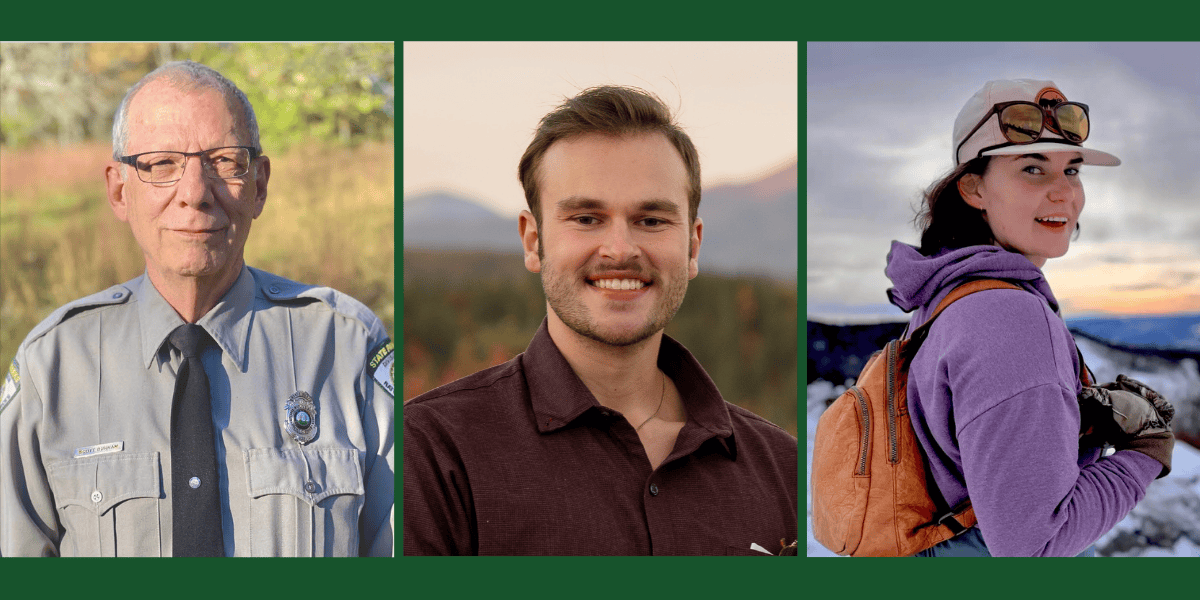
Scott Durham: I was born in Parkersburg but have lived around the state except for ages eight to 14 when I lived in my mom and dad’s hometown in Eastern Kentucky, which is a lot like Southern West Virginia. After that, we moved back to West Virginia. I live in Beckley now.
Cameron Layne: My name is Cameron Layne. I’m originally from Burton, Ohio, and I currently reside in Morgantown, West Virginia. The pursuit of my career as a fisheries biologist brought me to West Virginia initially and has kept me in the state’s embrace since 2020. I found my way to West Virginia through college, as I pursued an Associate of Science degree from Hocking College in fish management and aquaculture. Through a partnership program with Hocking College, I quickly followed my academic pursuits by obtaining my B.S. and, recently, my M.S. in Wildlife and Fisheries Management from West Virginia University.
Jocelyn Phares: Hello! I am Jocelyn Phares, and I am thrilled to be working with the West Virginia Highlands Conservancy. I began my career as a policy analyst for Friends of Blackwater, a local non-profit in Tucker County, before accepting a position with the West Virginia Division of Natural Resources (WVDNR). During my time at the WVDNR, I grew from an environmental resources analyst into the position of Federal Regulatory Commission coordinator, acting as a liaison between the state and federal government. I am currently an institutional research analyst at Davis & Elkins College and an adjunct professor of environmental law and policy at West Virginia Wesleyan College.
I am a West Virginian by birth, I am from Elkins, WV and currently live there. Growing up, my mother went back to school at West Virginia University, and I lived in Morgantown from the third grade all the way through my undergraduate degree at WVU. After graduation, I traveled and pursued higher education out west for around six years before returning to Elkins.
In early 2021, I received my J.D. and a certificate in natural resources law from Lewis and Clark College’s Northwestern School of Law, located in Portland, Oregon.
How did you get involved in environmental advocacy and conservation? Was there a turning point in your life where you knew you wanted to pursue this?
Scott Durham: The starting point was to be in a very outdoors-oriented Boy Scout Troop. My father took me to both Canaan Valley and Dolly Sods while I was a youngster in the early 1960s. Later, I was in the Navy after flunking out of Fairmont State in 1967, and while in the Navy, I spent a lot of time trying to figure out the rest of my life. Every time I was on leave, I tried to visit, camp, and hike in Dolly Sods. One time, while on leave, I visited a friend who worked at Audra State Park. I went back to the Navy with a plan to be a park ranger. To be more succinct, it was the Boy Scouts and Dolly Sods. Since I had family in Kentucky and West Virginia, I knew I could live in either place, but I was drawn to the more wild and rugged quality of West Virginia.
Cameron Layne: From a young age, I knew that I wanted to become a steward of our natural resources. I sought to practice this as early as I could through volunteering with local parks, interning, and finding employment with natural resource organizations. Yet, it was my employment with the West Virginia Division of Natural Resources that spurred my passion for environmental advocacy and conservation. I worked as a fisheries technician and an assistant non-game fish biologist, where I practiced endangered species conservation, aquatic habitat evaluations, and data collection. The turning point for me was my first time working with Candy Darters and seeing just how fragile, yet beautiful, this species and its habitat were.
Jocelyn Phares: I would not say there was a specific turning point in my life that inspired me to pursue my passion for environmental advocacy; it has always been there. West Virginians are raised with a unique relationship to natural places and spaces. Elkins and the surrounding areas are especially beautiful. Even as a child, I think I recognized they are worth protecting. As an adult, I chose to pursue environmental advocacy in my career and side interests because I could never see myself doing something I did not care deeply about, and I care deeply about this place.
How did you learn about the West Virginia Highlands Conservancy?
Scott Durham: I don’t remember – I have been a member for a long time. I joined to support the mission and to stay informed on what goes on in the Highlands. The Mon is where my heart is, and Dolly Sods is where my soul is.
Cameron Layne: I learned about the West Virginia Highlands Conservancy through my education at West Virginia University. Word of mouth about the organization and posters for the WVHC hanging in Percival Hall caught my attention between classes.
Jocelyn Phares: Growing up in the area, particularly in the 90s, the Conservancy was one of the only environmental conservation organizations in the area. I think the first time I learned about it, I was asking about an ‘I ❤️ Mountains’ sticker in the White Grass parking lot as a kid.
What is the best advice you could give to someone who is looking to get involved in environmental advocacy?
Scott Durham: Have a vision and then make decisions that fit the vision. Finally, be patient but don’t give up. After the years pass, you will be surprised by the impact you have had.
Cameron Layne: The best advice I can give to someone looking to get involved in environmental advocacy is to expand your repertoire, never lose sight of your passion, and make new friends in the field. Certifications, background experience, and your network all matter greatly in not only the pursuit of a career in such a field, but also in becoming an advocate in general.
Jocelyn Phares: Volunteer, show up, and network! The community is small and very welcoming. It can be competitive career-wise, but the best way to get your foot in the door is to show you care!
What is your favorite natural landscape to visit in West Virginia? Why is it your favorite?
Scott Durham: My favorite is the Allegheny Front, with the best being Dolly Sods and Cheat Mountain.
Cameron Layne: The Greenbrier River is my favorite natural landscape to visit in West Virginia. This river not only holds sentimental value to me through my work but also resides in one of the quietest regions of the state. This really allows me to connect with the natural beauty of the river and its surrounding landscape. Additionally, the nearby scenery and aquatic inhabitants are nothing short of breathtaking.