
By Valerie Staats, West Virginia Highlands Conservancy Member
It was on West Virginia State Road 26, between Bruceton Mills and Kingwood. A two-lane road, no shoulders, all curves and gentle hills, with drivers flying along as if it were a Formula One track. This section of the road runs beside the beautiful Cheat River. I saw the turtle near the double yellow line, stock-still and possibly dead, facing the road’s high side away from the river. I had to stop. In jeans and steel-toed boots, gray hair flying in the breeze, I picked my way along the edge of the road, perhaps half a football field away, to the turtle. Every time a car or pickup truck came racing along from either direction, I patted the air down with both my hands in what I hoped was a universal gesture for “slow down and look.” Every time, I held my breath and waited for the smush. To my happy surprise, every traveler did slow down and guided their wheels around the turtle.
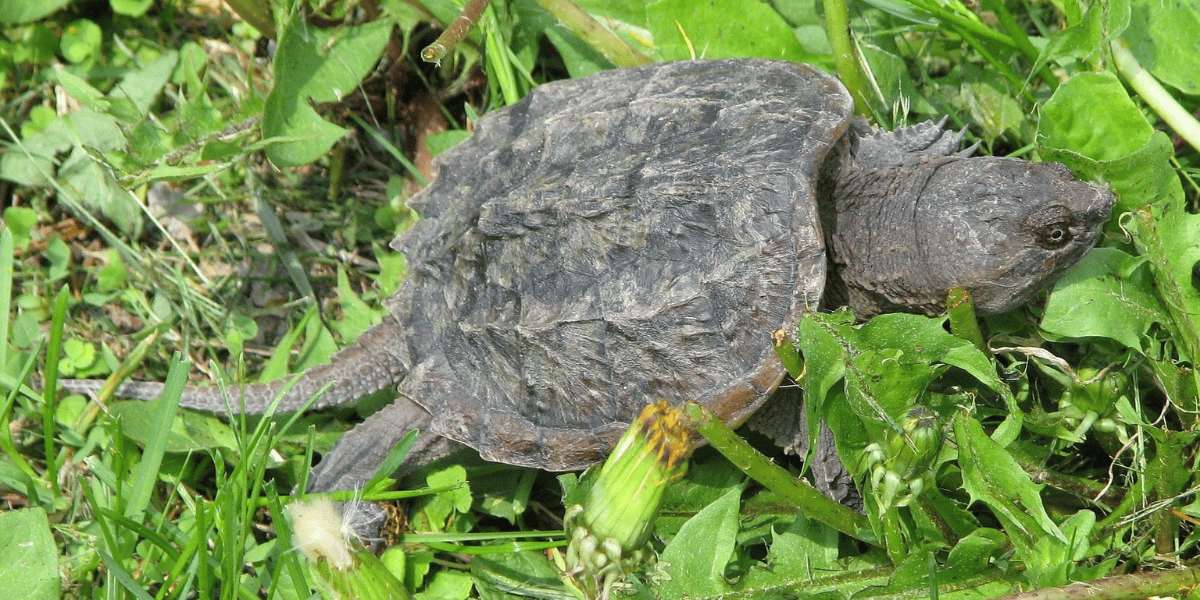
I approached. It was big, about a foot long, dark brown with no noticeable markings, and had a spiky, curved tail sticking out about six inches, a face and four legs and feet as wrinkly as time itself. It was definitely alive, though still. I tried moving it along with my boot toe but got nothing doing. It reacted to my gestures, but would not go. I grabbed a long, solid stick from the roadside and tried prodding the old gal or guy to get moving. Still nothing. I admit I was afraid to pick it up. I had no gloves. What if it bit me and wouldn’t let go? I’d heard stories. I knew that turtle jaws were incredibly strong. Was this a snapping turtle? I wanted to move it, but I was chicken. Cars kept coming. Finally, I gave up and left the turtle to its fate, whatever that would be.
Fate delivered. A sporty white car with a black roof zipped by. It stopped, but too far ahead to do anything. The driver took off again. I trudged on toward my car. Suddenly, I saw the little white car come roaring back from the other direction. I half-feared that the driver was going to chastise me, maybe disapproving of my being in the road or trying to interfere with drivers, or both. The driver hit the brakes right beside the turtle, jumped out, picked up the turtle with both bare hands, and carried it the rest of the way across the road. I clapped and shouted my thanks, and he gave me a quick wave. Then he jumped back into the car and took off, reappearing moments later heading back in his original direction, roaring on.
Maybe that kind young man saved my life, too.
The common snapping turtle (Chelydra serpentina) is widespread in West Virginia and is the most commonly found turtle in the Cheat River (Dahle, Lindsey, birdwatchinghq.com, undated, accessed Sept. 5, 2026). Snapping turtles are omnivores that eat “almost anything they encounter that is edible and smaller than they are” (Richards, Paul, fieldandstream.com, Jan. 23, 2026, accessed Sept. 5, 2026). Friends of the Cheat, a nonprofit organization based in Kingwood, is a key resource on Cheat River wildlife (cheat.org).