By Willie Dodson, Appalachian Voices
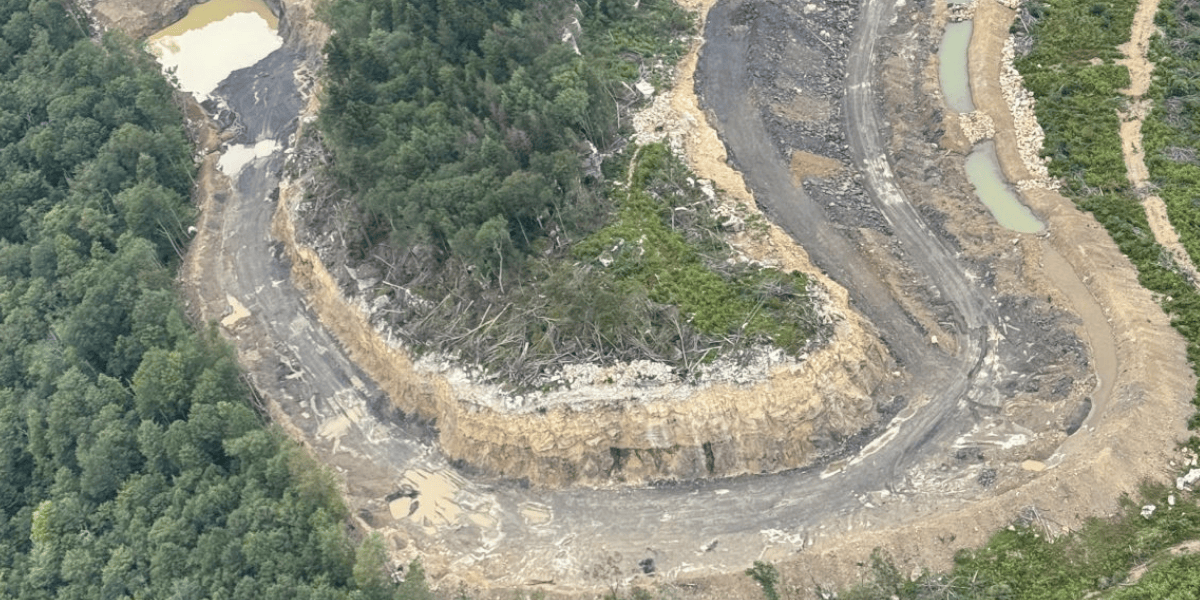
Our collective efforts to defend the Monongahela National Forest and the Cherry River from the abuses of South Fork Coal Company are having an impact. Over the past few weeks, we became increasingly convinced that mining activity on the Rocky Run Surface Mine, and the hauling of coal through the national forest had ceased to a large degree. This was based on reports from local residents supportive of the “Don’t Mine the Mon” campaign, and from images captured via a fly-over of the area by Allegheny-Blue Ridge Alliance.
Those suspicions were confirmed on Aug. 15, when South Fork’s parent company, White Forest Resources, filed a motion in its bankruptcy proceedings acknowledging that it is unable to restructure and maintain operations, and that it will surrender its future to a court-appointed trustee who will oversee the liquidation of all the company’s mines and associated property. The conversion to Chapter 7 liquidation was approved by Judge Horan on Aug. 22 in the United States Bankruptcy Court for the District of Delaware.
To be clear — the bankruptcy South Fork Coal, White Forest Resources and its other affiliates declared in February was not the result of our advocacy. Like so many coal companies before it, the company is collapsing due to its own mismanagement, and due to regulatory schemes that enable companies to evade reclamation and environmental requirements for years.
This sort of lax regulation inevitably leads to situations where mining companies deplete their coal reserves and suddenly find themselves with massive environmental liabilities and little, if any, ability to generate cash flow.
Our role has been to simply utilize the courts and grassroots regulatory oversight in an attempt to enforce the laws that the company is breaking in its relentless assault on the Monongahela National Forest, the Cherry River and the greater Gauley River watershed.
What does this mean for our campaign?
White Forest Resources has not been able to find a willing buyer for the South Fork mines up to this point. Now that the company is liquidating, the court-appointed trustee will be tasked with selling off the company’s properties at bargain-bin rates. It’s difficult to predict how that will go, but in the past, when chronically non-compliant coal companies have declared bankruptcy and sold off their holdings that are high liability with low-to-no profitability, they haven’t often found buyers with stellar records.
For now, South Fork Coal Company is still on the hook for all its environmental compliance and reclamation obligations, and it is still culpable for polluting the treasured Cherry River and Monongahela National Forest. If and when another company acquires these operations, that company will become responsible for addressing any outstanding violations and litigation. Our groups will continue applying pressure until the 3,600 acres of mining scars that South Fork has inflicted on the landscape are properly reclaimed.
If no buyer comes forward, or if the mines are acquired by a deadbeat company that fails to clean up its messes, then it will be the responsibility of the West Virginia Department of Environmental Protection — the organization that issued the permits for these mines in the first place — to fully reclaim them.
“It was the West Virginia DEP that allowed this company to wreck the mountains and pollute the river,” said Olivia Miller, program director for the West Virginia Highlands Conservancy. “Now that the very predictable end of South Fork Coal is on the horizon, it’s time for the DEP to own its mistakes by seizing the company’s reclamation bonds and using that money to reclaim these mines. In fact, DEP should hire the miners who have lost their jobs through no fault of their own to perform this reclamation.”
Beyond the bankruptcy…
In January, the federal Office of Surface Mining Reclamation and Enforcement finally ordered South Fork to keep its coal trucks out of the national forest after conservation groups exposed the fact that the company had never demonstrated that it qualifies for an exception to the ban on mining and related activity in the national forest. (In fact, South Fork falsely claimed that no activity would occur in the Mon in its initial state mining application for “Haulroad #2,” 1.2 miles of which are indeed within the national forest.) In February, OSMRE reversed its decision, giving South Fork the greenlight to continue hauling coal through the Monongahela National Forest — despite lacking proper legal authorization. We have intervened in this proceeding and seek to reinstate the cessation order, which has been stayed through Sept. 2.
On July 18, OSMRE carved out an exception to the ban on mining and related activity in the national forest just for South Fork Coal Company by officially granting South Fork a determination of “valid existing rights.” But the valid rights determination relied on a previously issued Forest Service road use permit that was itself improper, as the Forest Service failed to ensure that the road would not violate the Endangered Species Act or National Environmental Policy Act. In January 2024, a wide coalition of West Virginia, regional and national groupssued the Forest Service over this, and that case is still ongoing.
On Aug. 15, our coalition formally appealed OSMRE’s July 18 determination to the Interior Board of Land Appeals, an administrative court within the Department of the Interior. Our appeal is based on the fact that federal law explicitly forbids OSMRE from making a decision on valid existing rights if the underlying claims are being litigated. In this case, the government’s underlying claim is that the Forest Service road use permit justifies OSMRE’s valid existing rights determination, but the road use permit is mired in a still unresolved lawsuit.
Alongside our appeal to the Interior Board of Land Appeals, we requested a stay to prevent coal trucks from resuming damage to this critical corridor while the case is pending. If the board refuses, we are prepared to take the fight to federal court to ensure the law is enforced and the Monongahela National Forest remains protected.
Further complicating matters (and further laying bare the federal government’s ridiculous posture of favoritism towards a coal company that is actively falling apart in front of our eyes), the Forest Service is now preparing to approve a new road-use permit designed to sidestep our litigation and paper over its earlier failures. This permit, too, is expected to bypass Endangered Species Act and National Environmental Policy Act requirements, this time by invoking a “categorical exclusion” meant for much smaller projects.
“As a citizen of the United States of America, I take seriously my responsibility for public lands that I share equitably with 340 million other citizens, as well as those who will be born or naturalized in the future,” said Allen Johnson, a local resident and coordinator of Christians for the Mountains. “To hastily rectify this illegality with a rubber stamp approval would be a slap in the face of us citizens who collectively are the owners of public lands.”
Violations continue to pile up
If the company’s past record of noncompliance — such as the violation it received for releasing “sludge” into a headwater stream in April, or any of the 80+ violations detailed in our December, 2024 lawsuit— wasn’t enough, new violations continue to come to light. On Aug. 11, Appalachian Voices, Allegheny-Blue Ridge Alliance and West Virginia Highlands Conservancy submitted a complaint and request for federal oversight to the OSMRE after aerial imagery collected on Aug. 5 showed multiple unpermitted discharges of orange water leaving the company’s Lost Flats and Laurel Creek contour mines. One of the discharges appeared to have carved out a rut along a mine access road, and was flowing in the direction of the South Fork of Cherry River — a popular trout fishing destination and designated critical habitat for the endangered candy darter.
Onward, we go
The Appalachian conservation community has rallied around the Cherry River and the Monongahela National Forest in recent years, and we will persist through the next phase of this fight. It is plain to see that South Fork lacks either the ability or the intention to operate in compliance with the law. The company shows no concern for the Monongahela National Forest, the Cherry River, the Gauley further downstream or the communities that depend on these waters.
The mad dash of regulators to rubber stamp this company’s operations are indefensible, legally dubious. Despite the government’s best efforts to prop up this bad actor, South Fork is now about to exit the scene. Whatever company comes next, and whatever moves regulators make, we will continue to advocate for the special places that this renegade mining has put at risk, and for the human and natural communities that are nourished and sustained by the land and water of our region.
Ultimately, we will hold the West Virginia Department of Environmental Protection accountable for ensuring that South Fork’s mines — whatever happens with the pending liquidation — are reclaimed.