By Dave Johnston, Dolly Sods Wilderness Stewards
The most fundamental principle of designated wilderness in the United States is that there should be as little human intervention in the natural environment as possible. Wilderness is intended to be untrammeled – free of human control and manipulation. To the extent possible, the goal of wilderness is to allow natural processes and events to play out on their own terms.
That doesn’t mean that wilderness is meant to exclude humans. To the contrary, the Wilderness Act specifically establishes the federal wilderness system so that people can enjoy the benefits of wilderness. But the presence of humans, and their use of the wilderness, must be compatible with preservation of the wilderness character for which the wilderness was created.
Accordingly, trails are created to provide people with a means of access to experience the wilderness. While trails themselves are a human mark on the wilderness, they allow people to be guided through the environment in a way that minimizes their impact and avoids more widespread evidence of human presence. Even so, wilderness trails are intentionally narrow, rocky and uneven, and less engineered than other trails, in keeping with the goal of a primitive experience.
Among the natural events that inevitably occur in wilderness are trees falling across those trails, and vegetation growing to encroach upon the trail passageway. Ideally, we could just let nature take its course, and treat these obstacles as part of the wilderness experience. But down trees tend to force people off the trail, where rogue bypass trails create new impact and increase erosion, and which can be unsafe, especially on steep hillsides. Similarly, overgrown trails encourage people to abandon the designated route and make their own paths, which frequently are poorly routed and destructive. Keeping the trails reasonably clear may minimize further, and more disruptive, damage to the wilderness environment.
So, a modest level of human intervention can be justified to maintain the trail corridor and thus protect the adjacent wilderness. But even this is still subject to limitations. In keeping with its ideal to be free of the trappings of mechanized modern civilizations, the Wilderness Act prohibits the use of motorized equipment. Chain saws, hedge trimmers and weed eaters need not apply.
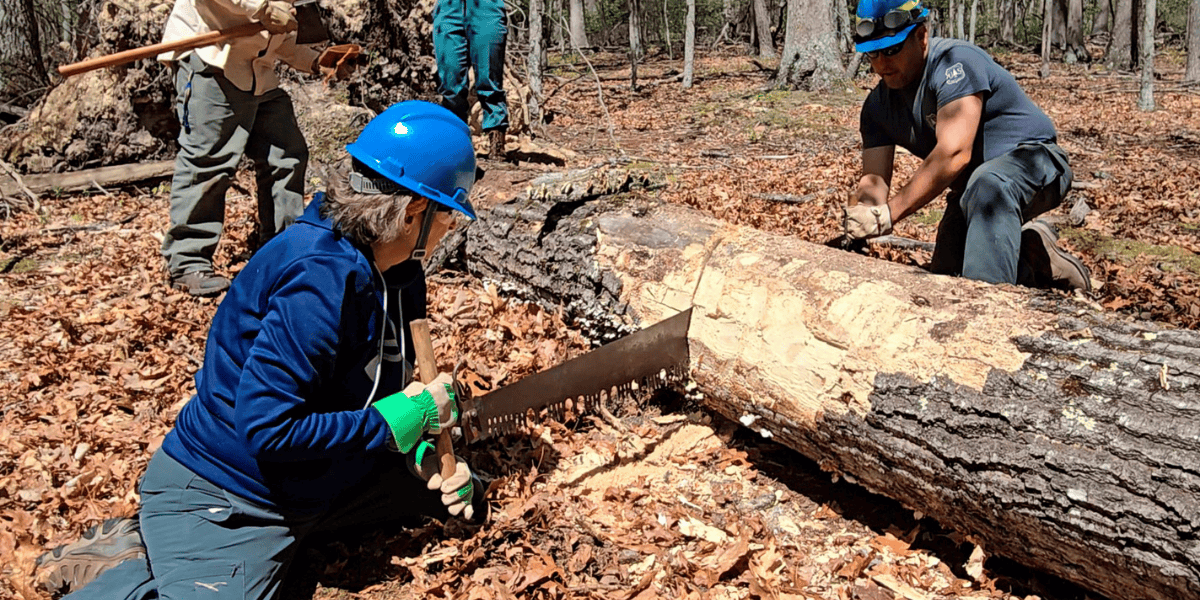
Enter – or reenter – the old-fashioned crosscut saw. This tried-and-true tool, which once contributed to the leveling of West Virginia’s forests, is now the key method of keeping the trails of our regrown wilderness forests clear. In wilderness, they are mostly used for bucking – cutting trees and limbs that have fallen and are essentially horizontal, which makes them perfect for clearing trails.
Despite their reputation, with proper training crosscut saws are not difficult or physically demanding to use, and can be fun. Crosscut sawyers learn a step-by-step process to define the desired outcome, analyze the forces acting on a log and how it will respond to cutting in order to plan their cut, identify potential hazards and an escape route, and how to safely control the behavior of the log as the cut is finished. For most cuts, gravity and the carefully honed action of the teeth do most of the work.
In 2023, the Dolly Sods Wilderness Stewards formed its Crosscut Sawyer team. Our sawyers are trained by the US Forest Service specialists, which leads to certification as an A or B-level sawyer, qualified to participate in bucking in the Monongahela National Forest. The men and women of our team work through the spring to clear the blown down trees that always occur during the bitter Dolly Sods winters, and remain available to respond to reports of down trees during the rest of the season.
Not surprisingly, the making of crosscut saws is a craft that died out long ago. While saws made these days are usable, they are not the equal of those made and used decades ago. Crosscut sawyers seek out legacy saws that can be refurbished and returned to useful service.
Highlands Conservancy members Cindy Rank and Larry Thomas donated saws that had been hanging in their sheds for years, rusty but intact, to the Wilderness Stewards. Cleaned up with a bit of elbow grease and sharpened by the Forest Service saw specialist, these saws are now being actively used by the Stewards’ Crosscut team – and they cut like a butter knife!
In addition to crosscut saws, we use other hand tools to keep the trail clear. Hand saws are more appropriate for smaller branches impinging on the trail and can be carried on even routine hikes. We use single- and double-bit axes for cases where a saw would be unwieldy or potentially damaged. And with loppers we try to regularly cruise the trails to keep the fast-growing rhododendron and laurel at bay. The Crosscut Sawyer team is busy with trail clearing projects throughout the season!
The Crosscut team now has a full complement of tools, and a solid core of qualified sawyers take on the challenges of keeping the trails of Dolly Sods open for visitors to experience the wilderness while protecting the surrounding resource. But with more volunteers we can do more. We’d like to more regularly monitor the trails of Dolly Sods, and also expand to begin covering the trails of Roaring Plains West, Otter Creek and the Laurel Fork wilderness areas of northern West Virginia.
We’d like you to consider joining us. We are inviting new volunteers to participate in the next Crosscut Sawyer training by the Forest Service, to be held the weekend of March 14-15 at Seneca Rocks. The training takes place over two days, with Saturday in the classroom covering the principles, tools and techniques of crosscut and axe work. Then Sunday is in the field, putting those concepts into practice and picking up the needed skills. This leads to certification as either an A or B-level sawyer, and you’ll be part of the team keeping the trails in Dolly Sods passable.
Sawyer certification requires certification in at least Basic First Aid/CPR. If you do not already have that, you can attend the first aid class the Forest Service is offering on Friday, the day before, also at Seneca Rocks. If you aren’t able to make that, your crosscut certification will simply be pending and you can still work with use on project on the wilderness trails. To sign up, first go to this link (https://www.wvhighlands.org/dolly-sods-wilderness-stewards-form/) and fill out the form to become a Wilderness Steward. Then go to this link (http://bit.ly/4cIQfSI) and sign up for the training. There is a limit to how many can be in the training, but if that is exceeded, you’ll be added to a wait list.
If you have any questions, email the Wilderness Stewards coordinator at dollysodsstewards@wvhighlands.org.