By Jordan Howes, West Virginia Highlands Conservancy
Residents in southern West Virginia’s coalfield counties have lived for decades without reliable access to clean drinking water. In communities across McDowell, Wyoming, Boone, Logan, Mingo, Lincoln, Mercer, Fayette and Raleigh counties, aging infrastructure, contamination and disinvestment have left many households relying on bottled water, roadside springs or unsafe tap water for daily use. This is an unacceptable reality for citizens living in the wealthiest nation in the world.
Reverend Caitlin Ware, co-director of From Below: Rising Together for Coalfield Justice, said the problem has persisted for generations, but only recently has begun receiving sustained attention.
“It’s existed for 25 to 50 years in some areas, but people just kind of gave up,” Ware said. “They didn’t want to talk about it… they were like, it’s not going to change. We just have to figure out how to adapt.”
From Below began as an immersion project intended to connect faith communities in northern West Virginia with residents in the southern coalfields, Ware said.
“Initially, we actually started as an immersion group,” she said. “We wanted to find ways that we could get people… particularly north of I-64, to just be aware of what’s happening in the coalfields and then come down, see what’s happening, talk with residents.”
The organization’s focus shifted in 2024 after Ware and her co-director, Rev. Brad Davis, began speaking with residents in Wyoming County about what they believed was a temporary water emergency.
“They all start laughing,” Ware said. “And they’re like, ‘We haven’t had clean water in years.’ And he’s like, ‘Oh—so this is a much bigger problem.’”
Further conversations revealed a pattern common across former coal towns, where water systems were built by mining companies in the early 20th century and later abandoned as the industry declined.
“Suddenly, your town has no industry,” Ware said. “The people that were maintaining your water system are gone. And so, who’s going to maintain the system and who’s going to have the money to do it?”
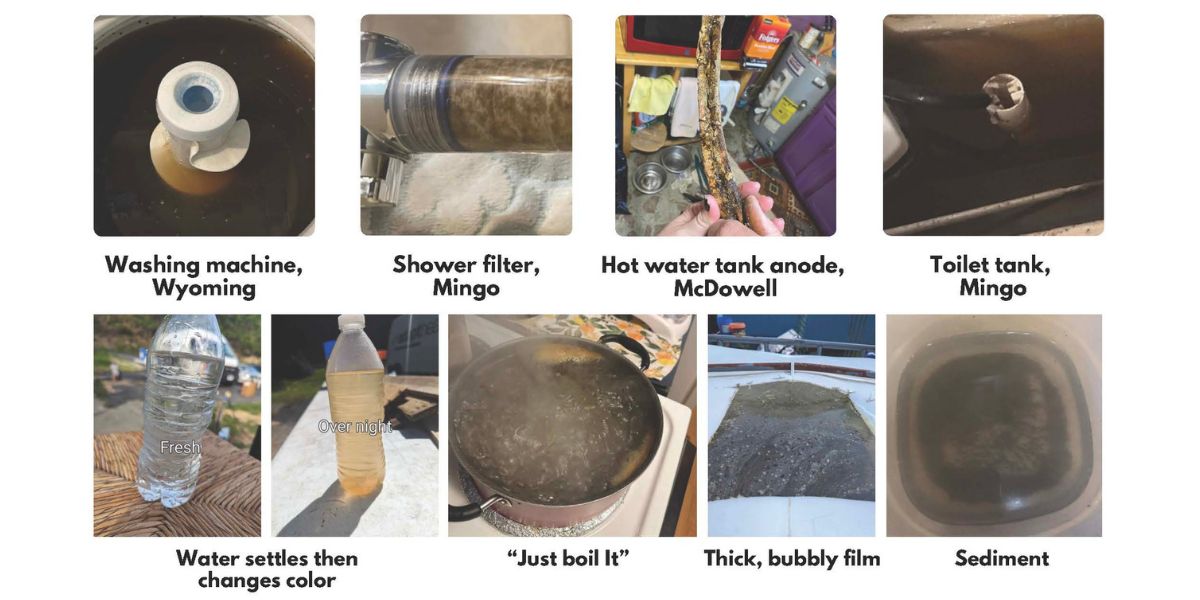
As infrastructure aged and investment declined, residents in many communities were left with limited options. Ware said water in some areas runs black, orange, pink or yellow and may contain contaminants including lead, fecal matter, iron, manganese or methane.
In Wyoming County, she said methane contamination caused wells and, in some cases, homes to explode.
“Some people were told they should not bathe in it,” Ware said. “But what else are they going to do? It’s not like you can bathe in the creeks.”
In McDowell County, many residents collect water from roadside springs because it appears clearer than what comes from their taps.
“They take jugs and they collect water in jugs off the side of a road,” Ware said. “Some people have to spend up to $150 a month on bottled water.”
Even when bottled water is used for drinking, residents often continue to bathe, wash clothes and clean with contaminated water, which Ware said damages plumbing and appliances.
“You’re choosing the color of the clothes you buy based on how the water’s going to stain it,” she said. “I just watched somebody washing their bed sheets in Gary [West Virginia] water the other day and it just stained it brown.”
State and federal data cited in a support letter for the proposed Coalfield Clean Water Act describe the issue as a long-standing public health crisis. According to the letter, “Southern coalfield counties have been experiencing a public health crisis for decades due to our lack of access to safe drinking water.” It also states that, “Public drinking water tested by the West Virginia Department of Environmental Protection in McDowell County revealed high levels of fecal matter and lead.”
The letter further notes that “Wyoming, Boone, and Mercer are the top three counties in America for most public water violations.” Despite that, only a small portion of recent federal water funding has gone to the region. “Only 2.5% of $432.4M in water and wastewater funds from the American Rescue Plan Act, 4 out of 161 projects, were awarded by the West Virginia Water Development Authority to southern coalfield communities.
Ware said funding decisions have historically favored northern parts of the state.
“The state has only been sending money north,” she said. “Even for the last two years… almost all of [the projects] are in the north.”
The proposed Coalfield Clean Water Act would expand the circumstances under which the state can use money from its Revenue Shortfall Fund, also known as the Rainy Day Fund. Current law allows those funds to be used for infrastructure primarily in response to natural disasters.
“The Coalfield Clean Water Act amends state code to include public health crises as a permissible use of emergency infrastructure funds from the Revenue Shortfall Fund (Rainy Day Fund),” the support letter on behalf of From Below states.
Supporters say the change would allow lawmakers to appropriate $250 million for water infrastructure projects in southern coalfield counties while maintaining the minimum fund balance required to protect the state’s bond rating. According to the letter, “This allocation will fund the highest priority projects already approved and included in the fiscal year 2027 DEP Drinking Water Intended Use Plan.” Funds would be distributed to public service districts and municipal water boards in nine counties.
Ware said many communities already have completed engineering plans but cannot proceed without sufficient funding.
“They know what needs done. They know the entire engineering plan,” she said. “They can’t move on it because of the funding.”
Supporters of the bill argue that clean water infrastructure is essential to economic development. The letter states, “Without adequate water and wastewater infrastructure, drawing new industry to our region simply cannot and will not happen.”
Ware said arguments against investing in small or rural communities have contributed to population decline.
“That’s why these communities keep getting bypassed,” she said. “And that’s why these communities keep shrinking.”
The bill has bipartisan sponsorship, including Del. David Green, R-McDowell, and Del. Anitra Hamilton, D-Monongalia, who is originally from McDowell County. Ware said the legislation should be viewed as an investment rather than an expense.
“This is an economic development bill,” she said. “There are no jobs with no water.”
Despite the lengthy timeline for infrastructure projects, Ware said momentum is building.
“There’s not really a choice,” she said. “People are fed up. People want to see change, so we are working with that momentum as much as we can.”
Even if passed, the legislation would take years to fully address the crisis. Ware said the proposal represents a first step toward accountability.
“It’s our time, it’s our turn,” she said. “It [the Coalfield Clean Water Act] is a good faith effort to say that the state cares to do something.”
Those interested in following the Coalfield Clean Water Act during the 2026 legislative session can track bill activity through the West Virginia Legislature’s official website or contact their representatives using this link. Updates and information about the water crisis in the southern coalfields are also shared by From Below: Rising Together for Coalfield Justice through its Facebook page and mailing list.