
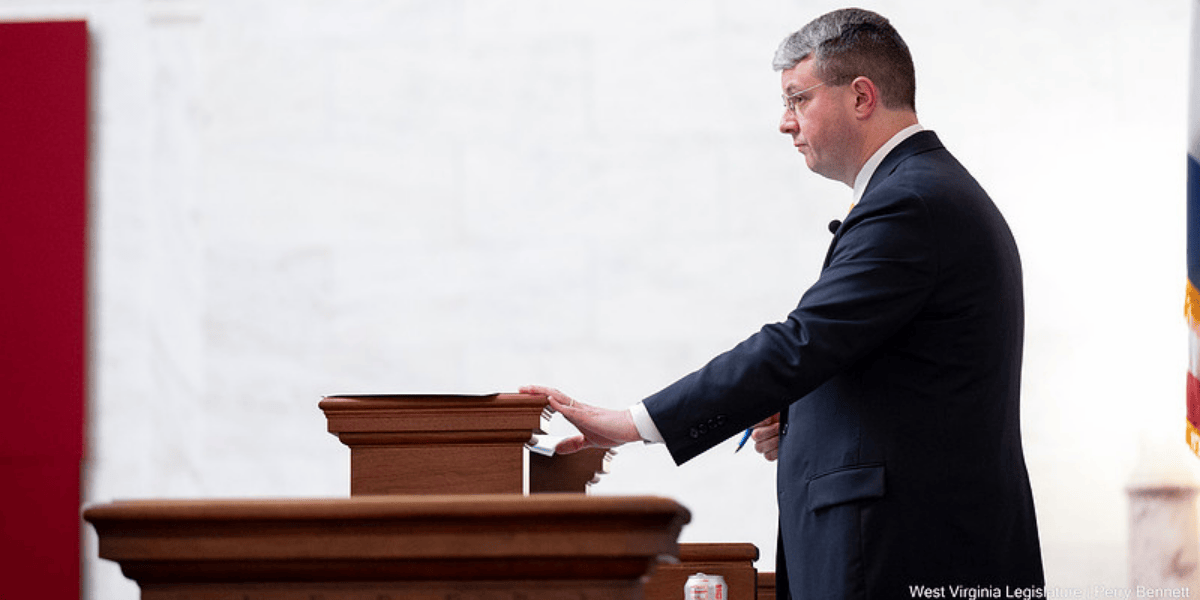
By Caity Coyne, West Virgina Watch
WV Citizen Action Group calls for Hanshaw to resign from all legal cases related to developers in the state who could benefit from legislation he’s passed.
West Virginia House Speaker Roger Hanshaw is representing a second data center-related developer against a community group that is seeking to appeal an air quality permit previously approved by the state Department of Environmental Protection for a development in Mason County.
Hanshaw, an attorney with the Bowles Rice law firm, filed a notice of appearance in the appeal to the DEP’s Air Quality Board on Feb. 12. One week later, the state House of Delegates passed legislation directing how the Department of Commerce will certify new high impact data centers and microgrids in the state and what information developers are required to provide for certification.
A spokesperson for Bowles Rice confirmed via email on Thursday that Hanshaw is assigned to the Mason County case, where he and two other attorneys are representing the developer MGS CNP1, LLC, which is an affiliate of Houston-based Fidelis New Energy. The West Virginia Citizen Action Group is seeking the appeal.
The news comes one week after Country Roads News, in Tucker County, reported that Hanshaw would be defending data center developer Fundamental Data against an air quality permit appeal filed by the grassroots coalition Tucker United in the state’s Intermediate Court of Appeals.
Hanshaw started working on the case on March 16, two days after the 2026 regular session ended.
Hanshaw is currently seeking re-election to his seat in the House of Delegates, where he represents Clay, Calhoun and Braxton counties. He does not have a Republican challenger for the May primary.
In Mason County, CAG is appealing an air quality permit that was approved last year for the construction of a biomass and carbon-capture facility in Point Pleasant. According to public filings with the DEP, that facility — which is just one part of a very complicated campus, dubbed the Monarch Campus, planned by several companies and industries that will include data centers — plans to burn wood chips to generate electricity that won’t be for sale to the grid.
Morgan King, climate manager for WV CAG, said Hanshaw’s decision to work on the Mason County case is a “massive conflict of interest.” As speaker, Hanshaw holds a lot of power in the House of Delegates, she said. He’s instrumental in passing legislation like House Bill 2014, the 2025 bill that started the state’s certified microgrid and data center program.
While it’s not illegal for Hanshaw to represent organizations that may benefit from bills approved by the House of Delegates, King said it is alarming.
“There are plenty of laws in place that are permissible, but that doesn’t make them right or ethical,” King said. “That’s CAG’s biggest concern — we see these conflicts of interest time and time again that our legislators don’t stand up to or fix. [The House and Hanshaw] approved the tax credits, the loose regulations, the rules for [developers]. Now he’s working as their lead counsel.”
Ann Ali, communications director for the state House of Delegates, said Wednesday that Hanshaw could not comment on the clients he represents through his law firm.
A spokesperson for Bowles Rice declined to comment for this story.
Michelle Kuppersmith, the executive director of the government watchdog group Campaign For Accountability, said it was concerning to see one of the highest ranking legislators in West Virginia working on an appeal for a company that stands to benefit from legislation he passed.
“The status of state legislators as part-time state employees with zero restrictions on what their actual jobs that pay the bills can be, breeds an unfortunate level of corruption. This situation appears no different,” Kuppersmith said. “Best practice for state legislators is that they have caps on outside earnings and also restrictions on the kinds of investments that they are allowed to make to ensure there are no conflicts of interest between private jobs and holdings and the very important matters that they’re legislating on for the people of West Virginia. That’s not what seems to be happening here.”
The only piece of data center legislation passed during the 2026 Legislative session was a rules bundle directing how the state Department of Commerce should certify data centers and microgrids that would qualify for an expedited regulatory process and fewer regulations generally than other developments.
In the House, lawmakers — including Hanshaw — voted down an amendment to the rules that would have increased reporting requirements for developers, limited water usage, returned some power back to local governments and added other guardrails to alleviate concerns voiced by residents for the past year.
Under rules for the state’s House of Delegates, lawmakers who have a “direct personal or pecuniary interest” in matters being voted on should request a Rule 49 ruling from the House Speaker or “presiding officer” before voting. If the lawmaker is part of a class of more than five individuals, they are allowed to vote. Hanshaw did not request a Rule 49 ruling on the data center rules bundle.
King said that CAG will explore whether or not to file a complaint with the state’s Ethics Commission regarding Hanshaw’s involvement in the Mason County development. In Tucker County, community leaders have said they plan to do the same for his work with Fundamental Data. Per the Ethics Commission, state law bars complaints being filed against candidates running for public office during the 60 days before an election.
“We believe that Speaker Hanshaw should immediately resign from all the cases he’s handling related to industrial development and other developments that he has played a hand in advancing legislatively. He should not be their counsel,” King said. “The message the Legislature is sending to constituents about all these developments is that they will benefit from them, but [the developments] are really only benefiting people in power and wealthy stakeholders, both in and outside of the state.”